One codebase. Every platform. Native performance.

Perry is a native TypeScript compiler written in Rust. It takes your TypeScript and compiles it straight to native executables — no Node.js, no Electron, no browser engine. Just fast, small binaries that run anywhere.
Current Version: 0.5.1164 | Website | Documentation | Showcase
Community: Join the Perry Discord
perry compile src/main.ts -o myapp
./myapp    # that's it — a standalone native binary
Perry uses SWC for TypeScript parsing and LLVM for native code generation. The output is a single binary with no runtime dependencies.
Perry targets close behavioral parity with Node.js. Against Node's own test suite
(node v26.3.0, 53 node:* modules), Perry's native runtime passes ~97%
(2792 / 2863 cases), and overall Node/TypeScript compatibility sits around 95%.
Real implementations — not stubs — cover fs, http/https/http2, net/tls,
dns/dgram, crypto, stream (+ stream/web), events, child_process,
cluster, worker_threads, zlib, process, async_hooks /
AsyncLocalStorage, Atomics / SharedArrayBuffer (cross-thread), the WHATWG
web globals (fetch, URL, streams, structuredClone, WebCrypto, …), and ~50
popular npm packages. The remaining gap is a long tail of edge-case options and a
few categorical items (lookbehind regex, some console formatting). See
docs/runtime-parity-gaps.md.
Perry also compiles .js / .cjs / .mjs / .jsx source directly (parsed as
JavaScript, lowered through the same native pipeline as TypeScript) — no
TypeScript annotations required. There are no guarantees for every dynamic JS
pattern, but plain JavaScript projects compile and run in most cases.
People are building real apps with Perry today. Here are some highlights:
| Project | What it is | Platforms |
|---|---|---|
| Bloom Engine | Native TypeScript game engine — Metal, DirectX 12, Vulkan, OpenGL. Write games in TS, ship native. | macOS, Windows, Linux, iOS, tvOS, Android |
| Mango | Native MongoDB GUI. ~7 MB binary, <100 MB RAM, sub-second cold start. | macOS, Windows, Linux, iOS, Android |
| Hone | AI-powered native code editor with built-in terminal, Git, and LSP. | macOS, Windows, Linux, iOS, Android, Web |
| Pry | Fast, native JSON viewer with tree navigation and search. | macOS, iOS, Android |
| dB Meter | Real-time sound level measurement with 60fps updates and per-device calibration. | iOS, macOS, Android |
Mango — Native MongoDB GUI (source)


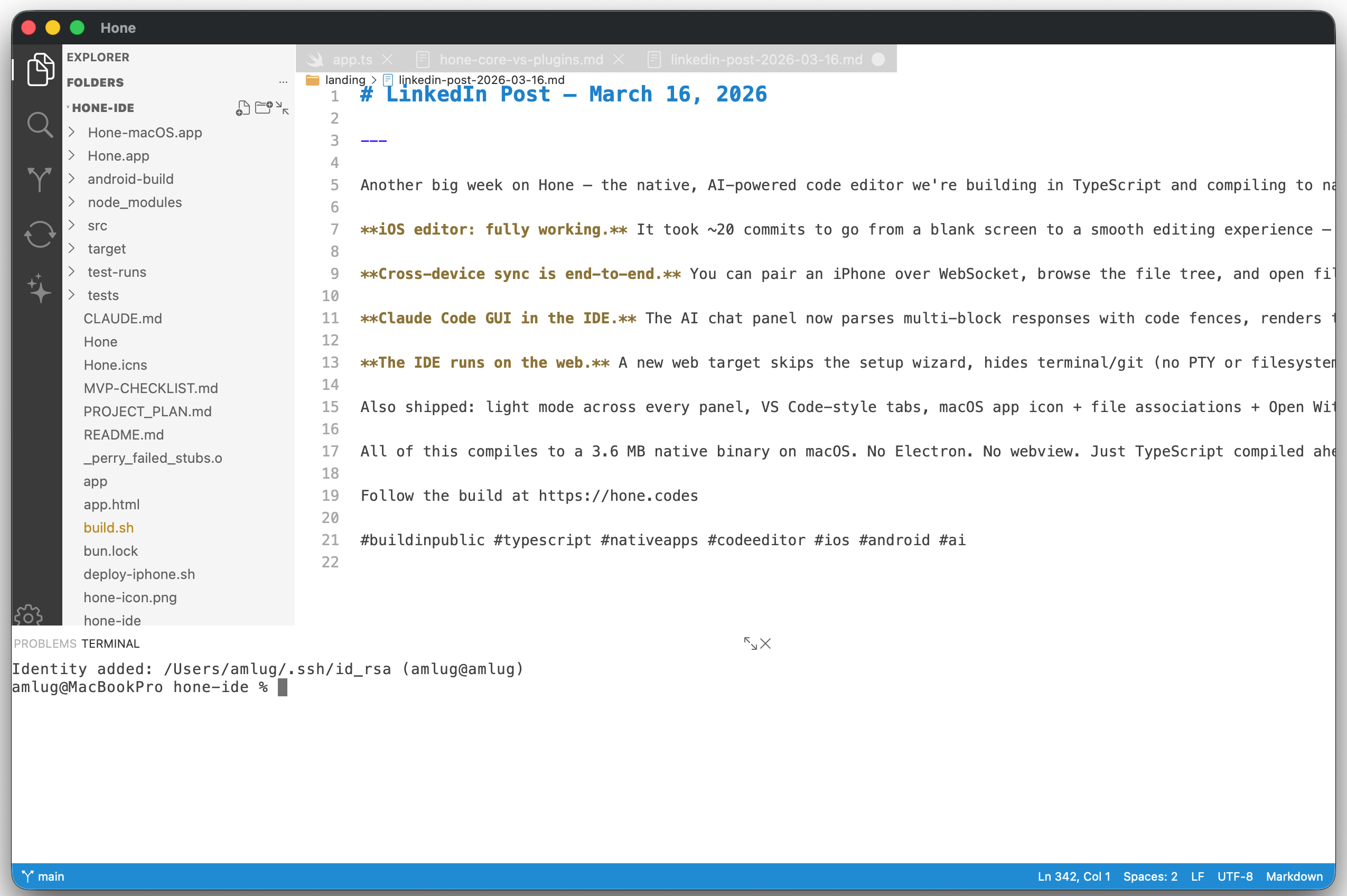
Hone — AI-powered native code editor (hone.codes)
Have something you've built with Perry? Open a PR to add it here!
As of v0.5.585, fast-math is opt-in. Perry's default mode emits no
reassoc + contractper-instruction FMF flags, so f64 arithmetic is bit-exact with Node.--fast-math(CLI),PERRY_FAST_MATH=1(env), or"perry": { "fastMath": true }inpackage.jsonre-enables the flags. Seedocs/src/cli/fast-math.mdfor the discussion of when it does and doesn't matter. The numbers below are Perry's default mode unless noted.
Numbers below are from a 2026-05-14 sweep on macOS ARM64 (M1 Max, RUNS=11 medians, taskpolicy -t 0 -l 0) at Perry v0.5.908 on an otherwise-idle machine. All languages re-measured together this run. Source + methodology in benchmarks/polyglot/.
| Benchmark | Perry | Rust | C++ | Go | Swift | Java | Node | Bun | What it tests |
|---|---|---|---|---|---|---|---|---|---|
| fibonacci | 309 | 316 | 309 | 446 | 401 | 278 | 987 | 518 | Recursive function calls (i64 specialization) |
| loop_data_dependent | 225 | 226 | 129 | 128 | 225 | 226 | 226 | 230 | Multiplicative carry through sum (genuinely-non-foldable f64) |
| object_create | 2 | 0 | 0 | 0 | 0 | 5 | 8 | 6 | Object allocation (1M objects, scalar replacement) |
| nested_loops | 18 | 8 | 8 | 10 | 8 | 10 | 17 | 20 | Nested array access (cache-bound) |
| array_read | 11 | 9 | 9 | 10 | 9 | 11 | 14 | 16 | Sequential read (10M elements) |
| array_write | 3 | 7 | 2 | 9 | 2 | 6 | 9 | 6 | Sequential write (10M elements) |
Default Perry runs in the same neighborhood as Rust default -O, C++ -O3, and Swift -O on every row — competitive on integer recursion (fibonacci 309 vs Rust 316 / C++ 309), within a tick of native on object allocation thanks to scalar replacement (object_create), within a few ms on cache-bound work (nested_loops, array_read/array_write), and matching the no-contract compiled pack on genuinely-non-foldable f64 (loop_data_dependent 225 vs Rust 226 / Bun 230 / Node 226). Apple Clang -O3 and Go default win the loop_data_dependent row at 128-129 by fusing sum * a + b into a single FMADDD instruction (FMA contraction is -ffp-contract=fast — a separate knob --fast-math deliberately doesn't toggle). Python column omitted to keep the table readable; full numbers in benchmarks/polyglot/RESULTS.md.
We deliberately don't lead with the trivially-foldable accumulator microbenchmarks (loop_overhead / math_intensive / accumulate) that Perry posted big numbers on through v0.5.584. Those are flag-aggressiveness probes — they measure whether each compiler applied reassoc + autovectorize to a sum += 1.0-shaped loop, not how fast the resulting loop computes under load. Perry default sits in the no-flags pack (97 / 51 / 97 ms in this sweep) on all three; --fast-math recovers 12 / 14 / 34 ms. C++ -O3 -ffast-math matches Perry --fast-math to the millisecond on the same kernels — same LLVM pipeline, one flag. The full breakdown is in benchmarks/README.md and polyglot/RESULTS_OPT.md.
Perry's broader benchmark suite covers workloads outside the polyglot set — closures, classes, JSON, prime sieve, etc. Numbers below from the 2026-05-14 v0.5.908 sweep via benchmarks/suite/run_benchmarks.sh (single-run-per-cell, not RUNS=11 medians — see benchmarks/polyglot/ for the rigorous multi-run methodology).
| Benchmark | Perry (v0.5.908) | Node.js | Bun | What it tests |
|---|---|---|---|---|
| factorial | 107ms | 591ms | 97ms | Modular accumulation (integer fast path) |
| method_calls | 9ms | 11ms | 9ms | Class method dispatch (10M calls) |
| closure | 50ms | 304ms | 51ms | Closure creation + invocation (10M calls) |
| binary_trees | 2ms | 10ms | 7ms | Tree allocation + traversal (1M nodes, scalar replacement) |
| string_concat | 0ms | 3ms | 1ms | 100K string appends |
| prime_sieve | 3ms | 8ms | 7ms | Sieve of Eratosthenes |
| mandelbrot | 28ms | 25ms | 29ms | Complex f64 iteration (800x800) |
| matrix_multiply | 28ms | 34ms | 34ms | 256x256 matrix multiply |
| json_roundtrip (lazy tape, gen-gc) | 83ms | 377ms | 249ms | 50× JSON.parse + JSON.stringify on a ~1MB, 10K-item blob |
closure and factorial are still slower than the older v0.5.173 baseline (10 → 50 ms, 31 → 107 ms). The v0.5.585 fast-math opt-in flip accounts for factorial (integer modulo plus an FP-tail reduction that the old default-on fast-math collapsed); closure regression is tracked as a follow-up. method_calls is back at baseline this sweep (9 ms) — yesterday's 25 ms reading was single-run noise from concurrent CPU load. The wins on binary_trees / string_concat / prime_sieve / mandelbrot / matrix_multiply against Node/Bun hold steady. Single-run cells are noisier than RUNS=11 medians; the lower-noise multi-run polyglot table above remains the canonical comparison.
Perry compiles to native machine code via LLVM — no JIT warmup, no interpreter overhead. Key optimizations that apply in both modes: scalar replacement of non-escaping objects (escape analysis eliminates heap allocation entirely — object fields become registers), inline bump allocator for objects that do escape, i32 loop counters for bounded array access, integer-modulo fast path (fptosi → srem → sitofp instead of fmod), elimination of redundant js_number_coerce calls on numeric function returns, and i64 specialization for pure numeric recursive functions.
Run benchmarks yourself: cd benchmarks/suite && ./run_benchmarks.sh (requires node, cargo; optional: bun, shermes).
Perry produces small, self-contained binaries with no external dependencies at run time:
| Program | Binary Size |
|---|---|
console.log("Hello, world!") |
~330KB |
hello world + fs / path / process imports |
~380KB |
| full stdlib app (fastify, mysql2, etc.) | ~48MB |
with --enable-js-runtime (V8 embedded) |
+~15MB |
Perry automatically detects which parts of the runtime your program uses and only links what's needed.
Perry ships as a prebuilt-binary npm package — the fastest way to try it, and the only install path that works on all seven supported platforms (macOS arm64/x64, Linux x64/arm64 glibc + musl, Windows x64) with one command:
# Project-local (recommended — pins Perry's version alongside your deps)
npm install @perryts/perry
npx perry compile src/main.ts -o myapp && ./myapp

# Global
npm install -g @perryts/perry
perry compile src/main.ts -o myapp

# Zero-install, one-shot
npx -y @perryts/perry compile src/main.ts -o myapp
@perryts/perry is a thin launcher; npm automatically picks the matching prebuilt via optionalDependencies (@perryts/perry-darwin-arm64, @perryts/perry-linux-x64-musl, etc.) based on your os / cpu / libc. Requires Node.js ≥ 16 and a system C toolchain for linking (same as any Perry install — see Requirements).
brew install perryts/perry/perrywinget install PerryTS.Perryscoop bucket add perry-ts https://github.com/PerryTS/perry
scoop install perry-ts/perryThe Scoop manifest declares main/llvm as a dependency, so scoop install automatically pulls the official MSVC-default LLVM toolchain Perry needs for Windows-native object emission. Verify with perry doctor after install.
curl -fsSL https://perryts.github.io/perry-apt/perry.gpg.pub | sudo gpg --dearmor -o /usr/share/keyrings/perry.gpg
echo "deb [signed-by=/usr/share/keyrings/perry.gpg] https://perryts.github.io/perry-apt stable main" | sudo tee /etc/apt/sources.list.d/perry.list
sudo apt update && sudo apt install perrycurl -fsSL https://raw.githubusercontent.com/PerryTS/perry/main/packaging/install.sh | shgit clone https://github.com/PerryTS/perry.git
cd perry
cargo build --release
# Binary at: target/release/perryPerry requires a C linker to link compiled executables:
- macOS: Xcode Command Line Tools (
xcode-select --install) - Linux: GCC or Clang (see below for your distro)
- Windows: MSVC (Visual Studio Build Tools)
Linux linker by distro:
# Debian / Ubuntu / Pop!_OS / Mint
sudo apt install build-essential

# Arch / Manjaro / CachyOS / EndeavourOS
sudo pacman -S base-devel gcc

# Fedora / RHEL / CentOS Stream
sudo dnf install gcc gcc-c++ glibc-devel

# openSUSE
sudo zypper install -t pattern devel_basis

# Alpine / musl-based
sudo apk add build-base

# Void Linux
sudo xbps-install -S base-devel
Run perry doctor to verify your environment.
# Initialize a new project
perry init my-project
cd my-project

# Compile and run
perry compile src/main.ts -o myapp
./myapp

# Or compile and run in one step
perry run .

# Check TypeScript compatibility
perry check src/

# Diagnose environment
perry doctorPerry supports standard ES module imports and npm packages. Here's a real-world API server with multi-file project structure:
Project layout:
my-api/
├── package.json
├── src/
│   ├── main.ts
│   ├── config.ts
│   └── routes/
│       └── users.ts
└── node_modules/
src/config.ts
export const config = {
  port: 3000,
  dbHost: process.env.DB_HOST || 'localhost',
};
src/routes/users.ts
export function getUsers(): object[] {
  return [
    { id: 1, name: 'Alice' },
    { id: 2, name: 'Bob' },
  ];
}

export function getUserById(id: number): object | undefined {
  return getUsers().find((u: any) => u.id === id);
}
src/main.ts
import fastify from 'fastify';
import { config } from './config';
import { getUsers, getUserById } from './routes/users';

const app = fastify();

app.get('/api/users', async () => {
  return getUsers();
});

app.get('/api/users/:id', async (request) => {
  const { id } = request.params as { id: string };
  return getUserById(parseInt(id));
});

app.listen({ port: config.port }, () => {
  console.log(`Server running on port ${config.port}`);
});
Compile and run:
perry compile src/main.ts -o my-api && ./my-api
# or: perry run .
The output is a standalone binary — no node_modules needed at runtime.
Ready-to-run demos live in their own repo: PerryTS/perry-examples.
| Example | Stack | What it demonstrates |
|---|---|---|
| express-postgres | Express + PostgreSQL | Multi-file routes, middleware (CORS, Helmet), connection pooling, error handling |
| fastify-redis-mysql | Fastify + Redis + MySQL | Rate limiting, caching layer, database queries, dotenv config |
| hono-mongodb | Hono + MongoDB | Lightweight HTTP framework with document database |
| nestjs-typeorm | NestJS + TypeORM | Decorator-based architecture, dependency injection |
| nextjs-prisma | Next.js-style + Prisma | ORM integration, database migrations |
| koa-redis | Koa + Redis | Middleware composition, session storage |
| blockchain-demo | Custom | Blockchain implementation in pure TypeScript |
git clone https://github.com/PerryTS/perry-examples
cd perry-examples/fastify-redis-mysql
npm install
perry compile src/index.ts -o server && ./serverPerry includes a declarative UI system (perry/ui) that compiles directly to native platform widgets — no WebView, no Electron. The programming model is SwiftUI-like: compose native widgets with stack-based layout, alignment, and distribution — not CSS/HTML.
import {
  App, VStack, HStack, Text, Button, Spacer, SplitView, splitViewAddChild,
  stackSetAlignment, stackSetDistribution, widgetAddChild, widgetMatchParentWidth,
} from 'perry/ui';

// Sidebar + content layout with a split view
const sidebar = VStack(8, [Text("Projects"), Text("Settings"), Spacer()]);
sidebar.setEdgeInsets(12, 12, 12, 12);
sidebar.setBackgroundColor("#F5F5F5");

const header = HStack(8, [Text("Dashboard"), Spacer(), Button("New", () => {})]);
const actions = HStack(8, [Button("Cancel", () => {}), Button("Save", () => {})]);
stackSetDistribution(actions, 1); // FillEqually — both buttons get equal width

const content = VStack(16, [header, Text("Welcome back!"), Spacer(), actions]);
content.setEdgeInsets(20, 20, 20, 20);
stackSetAlignment(content, 5); // Leading — children align left

const split = SplitView();
splitViewAddChild(split, sidebar);
splitViewAddChild(split, content);

App({ title: 'My App', width: 800, height: 500, body: split });
10 target outputs from one codebase:
| Platform | Backend | Target Flag |
|---|---|---|
| macOS | AppKit (NSView) | (default on macOS) |
| iOS / iPadOS | UIKit | --target ios / --target ios-simulator |
| visionOS | UIKit (2D windows) | --target visionos / --target visionos-simulator |
| tvOS | UIKit | --target tvos / --target tvos-simulator |
| watchOS | WatchKit | --target watchos / --target watchos-simulator |
| Android | Android Views (JNI) | --target android |
| Windows | Win32 | (default on Windows) |
| Linux | GTK4 | (default on Linux) |
| Web | DOM (JS codegen) | --target web |
| WebAssembly | DOM (WASM) | --target wasm |
127+ UI functions — widgets (Button, Text, TextField, Toggle, Slider, Picker, Table, Canvas, Image, ProgressView, SecureField, NavigationStack, ZStack, LazyVStack, Form/Section, CameraView, SplitView), layout control (alignment, distribution, match-parent, content hugging, overlay positioning, edge insets), and system APIs (keychain, notifications, file dialogs, clipboard, dark mode, openURL, audio capture).
The perry/thread module provides real OS threads with compile-time safety — no shared mutable state, no data races:
import { parallelMap, parallelFilter, spawn } from 'perry/thread';

// Data-parallel array processing across all CPU cores
const results = parallelMap([1, 2, 3, 4, 5], n => fibonacci(n));

// Parallel filtering
const evens = parallelFilter(numbers, n => n % 2 === 0);

// Background thread with Promise
const result = await spawn(() => expensiveComputation());
Values cross threads via deep-copy. Each thread gets its own arena and GC. The compiler enforces that closures don't capture mutable state.
Compile-time localization with zero runtime overhead:
import { t, Currency, ShortDate } from 'perry/i18n';

console.log(t('hello'));                    // "Hallo" (German locale)
console.log(t('items', { count: 3 }));     // "3 Artikel" (CLDR plural rules)
console.log(Currency(9.99, 'EUR'));         // "9,99 €"
console.log(ShortDate(Date.now()));        // "24.03.2026"
Configure in perry.toml:
[i18n]
default_locale = "en"
locales = ["en", "de", "fr", "ja"]
All locale strings are baked into the binary at compile time. Native locale detection on all 6 platforms. CLDR plural rules for 30+ locales.
Build native home screen widgets from TypeScript — iOS, Android, watchOS, and Wear OS:
perry compile src/widget.ts --target ios-widget -o MyWidget
perry compile src/widget.ts --target android-widget -o MyWidget
perry compile src/widget.ts --target watchos-widget -o MyWidget
perry compile src/widget.ts --target wearos-tile -o MyWidget# Desktop (default for host platform)
perry compile src/main.ts -o myapp
# Mobile
perry compile src/main.ts --target ios -o MyApp
perry compile src/main.ts --target ios-simulator -o MyApp
perry compile src/main.ts --target visionos -o MyApp
perry compile src/main.ts --target visionos-simulator -o MyApp
perry compile src/main.ts --target android -o MyApp
# TV / Watch
perry compile src/main.ts --target tvos -o MyApp
perry compile src/main.ts --target watchos -o MyApp
# Web
perry compile src/main.ts --target web -o app.html # JavaScript output
perry compile src/main.ts --target wasm -o app.wasm # WebAssembly output
# Home screen widgets
perry compile src/widget.ts --target ios-widget -o MyWidget
perry compile src/widget.ts --target android-widget -o MyWidget
perry compile src/widget.ts --target wearos-tile -o MyWidgetperry publish macos # or: ios / android / linuxperry publish sends your TypeScript source to perry-hub (the cloud build server), which cross-compiles and signs for each target platform.
| Feature | Status |
|---|---|
| Variables (let, const, var) | ✅ |
| All operators (+, -, *, /, %, **, &, |, ^, <<, >>, ???, ?., ternary) | ✅ |
| Control flow (if/else, for, while, switch, break, continue) | ✅ |
| Try-catch-finally, throw | ✅ |
| Functions, arrow functions, rest params, defaults | ✅ |
| Closures with mutable captures | ✅ |
| Classes (inheritance, private fields #, static, getters/setters, super) | ✅ |
| Generics (monomorphized at compile time) | ✅ |
| Interfaces, type aliases, union types, type guards | ✅ |
| Async/await, Promise | ✅ |
| Generators (function*) | ✅ |
ES modules (import/export, re-exports, import * as) |
✅ |
| Destructuring (array, object, rest, defaults, rename) | ✅ |
| Spread operator in calls and literals | ✅ |
| RegExp (test, match, replace) | ✅ |
| BigInt (256-bit) | ✅ |
| Decorators | emitDecoratorMetadata (details) |
| Module | Functions |
|---|---|
console |
log, error, warn, debug |
fs |
readFileSync, writeFileSync, existsSync, mkdirSync, unlinkSync, readdirSync, statSync, readFileBuffer, rmRecursive |
path |
join, dirname, basename, extname, resolve |
process |
env, exit, cwd, argv, uptime, memoryUsage |
JSON |
parse, stringify |
Math |
floor, ceil, round, abs, sqrt, pow, min, max, random, log, sin, cos, tan, PI |
Date |
Date.now(), new Date(), toISOString(), component getters |
crypto |
randomBytes, randomUUID, sha256, md5 |
os |
platform, arch, hostname, homedir, tmpdir, totalmem, freemem, uptime, type, release |
Buffer |
from, alloc, allocUnsafe, byteLength, isBuffer, concat; instance methods |
child_process |
execSync, spawnSync, spawnBackground, getProcessStatus, killProcess |
Map |
get, set, has, delete, size, clear, forEach, keys, values, entries |
Set |
add, has, delete, size, clear, forEach |
setTimeout/clearTimeout |
✅ |
setInterval/clearInterval |
✅ |
worker_threads |
parentPort, workerData |
These packages are natively implemented in Rust — no Node.js required:
| Category | Packages |
|---|---|
| HTTP | fastify, axios, node-fetch, ws (WebSocket) |
| Database | mysql2, pg, ioredis |
| Security | bcrypt, argon2, jsonwebtoken |
| Utilities | dotenv, uuid, nodemailer, zlib, node-cron |
| Container | perry/container (OCI container management) |
Perry includes a native container management module perry/container for creating, running, and managing OCI containers:
import { run, list, composeUp } from 'perry/container';

// Run a container
const container = await run({
  image: 'nginx:alpine',
  name: 'my-nginx',
  ports: ['8080:80'],
});

// List containers
const containers = await list();
console.log(containers);

// Multi-container orchestration
const compose = await composeUp({
  services: {
    web: { image: 'nginx:alpine' },
    db: { image: 'postgres:15-alpine' },
  },
});
Platform support:
- macOS/iOS: Podman (apple/container support coming soon)
- Linux: Podman (native)
- Windows: Podman Desktop (experimental)
See example-code/container-demo/ for a complete example.
Perry can compile pure TypeScript/JavaScript npm packages directly to native code instead of routing them through the V8 runtime. Add a perry.compilePackages array to your package.json:
{
  "perry": {
    "compilePackages": [
      "@noble/curves",
      "@noble/hashes",
      "superstruct"
    ]
  }
}
Then compile with --enable-js-runtime as usual. Packages in the list are compiled natively; all others use the V8 runtime.
Good candidates: Pure math/crypto libraries, serialization/encoding, data structures with no I/O. Keep as V8-interpreted: Packages using HTTP/WebSocket, native addons, or unsupported Node.js builtins.
- Scalar Replacement — escape analysis identifies non-escaping objects (
let p = new Point(x, y); sum += p.x + p.y); fields are decomposed into stack allocas that LLVM promotes to registers — zero heap allocation - NaN-Boxing — all values are 64-bit words (f64/u64); no boxing overhead for numbers
- Generational Mark-Sweep GC — per-thread nursery + old-gen arenas, precise shadow stack + conservative stack scan, two-bit aging, 8-byte GcHeader per alloc
- Inline Bump Allocator — objects that do escape use a 13-cycle inline arena bump (no function call on hot path)
- Parallel Compilation — rayon-based module codegen, transform passes, and symbol scanning across CPU cores
- FMA / CSE / Loop Unrolling — fused multiply-add, common subexpression elimination, 8x loop unroll
- Fast-Math Flags —
reassoc contracton all f64 ops enables LLVM to break serial accumulator chains into parallel accumulators + NEON vectorization - Integer-Modulo Fast Path —
fptosi → srem → sitofpinstead offmodfor provably-integer locals (64x speedup on factorial) - i64 Specialization — pure numeric recursive functions compile to native
i64registers (no f64 round-trips) - i32 Loop Counters — integer registers for loop variables (no f64 round-trips)
- LICM — loop-invariant code motion for nested loops
- Shape-Cached Objects — 5-6x faster object allocation for escaping objects
- TimSort — O(n log n) hybrid sort for
Array.sort() __platform__Constant — compile-time platform elimination (dead code removal per target)
Compile TypeScript as a native shared library plugin:
perry compile my-plugin.ts --output-type dylib -o my-plugin.dylibimport { PluginRegistry } from 'perry/plugin';
export function activate(api: any) {
api.registerTool('my-tool', (args: any) => { /* ... */ });
api.on('event', (data: any) => { /* ... */ });
}Perry includes Geisterhand, an in-process UI testing framework with HTTP-driven interaction and screenshot capture:
perry compile src/main.ts --enable-geisterhand -o myapp
./myapp
# UI test server runs on http://localhost:7676
Supports screenshot capture on all native platforms. See the Geisterhand docs for details.
| Package | Description |
|---|---|
| Bloom Engine | Native TypeScript game engine — 2D/3D rendering, skeletal animation, spatial audio, physics. Metal/DirectX 12/Vulkan/OpenGL. |
| perry-react | React/JSX that compiles to native widgets. Standard React components → native macOS/iOS/Android app. |
| perry-sqlite | SQLite with a Prisma-compatible API (findMany, create, upsert, $transaction, etc.) |
| perry-postgres | PostgreSQL with the same Prisma-compatible API |
| perry-prisma | MySQL with the same Prisma-compatible API |
| perry-apn | Apple Push Notifications (APNs) native library |
| @perryts/threads | Web Worker parallelism (parallelMap, parallelFilter, spawn) for browser/Node.js |
| perry-starter | Minimal starter project — get up and running in 30 seconds |
| perry-demo | Live benchmark dashboard comparing Perry vs Node.js vs Bun |
| perry-react-dom | Perry React DOM bridge |
Write React components that compile to native widgets — no DOM, no browser:
import { useState } from 'react';
import { createRoot } from 'react-dom/client';

function Counter() {
  const [n, setN] = useState(0);
  return (
    <div>
      <h1>Count: {n}</h1>
      <button onClick={() => setN(n + 1)}>+</button>
    </div>
  );
}

createRoot(null, { title: 'Counter', width: 300, height: 200 }).render(<Counter />);Drop-in replacements for @prisma/client backed by Rust (sqlx):
import { PrismaClient } from 'perry-sqlite';

const prisma = new PrismaClient();
await prisma.$connect();

const users = await prisma.user.findMany({
  where: { email: { contains: '@example.com' } },
  orderBy: { createdAt: 'desc' },
  take: 20,
});

await prisma.$disconnect();| Command | What it does |
|---|---|
perry compile <input.ts> -o <output> |
Compile TypeScript to a native binary |
perry run <path> [platform] |
Compile and run in one step (supports ios, android, etc.) |
perry init <name> |
Scaffold a new project |
perry check <path> |
Validate TypeScript compatibility without compiling |
perry publish <platform> |
Build, sign, and publish via the cloud build server |
perry doctor |
Check your development environment |
perry i18n extract |
Extract translatable strings from source |
-o, --output <name>      Output file name
--target <target>        ios | ios-simulator | visionos | visionos-simulator |
                         tvos | tvos-simulator | watchos | watchos-simulator | android |
                         web | wasm | ios-widget | android-widget |
                         wearos-tile | watchos-widget
--output-type <type>     executable | dylib
--enable-js-runtime      Embed V8 for npm package compatibility (+~15MB)
--enable-geisterhand     Enable UI testing server
--print-hir              Print HIR for debugging
perry/
├── crates/
│   ├── perry/                  # CLI (compile, run, check, init, doctor, publish)
│   ├── perry-parser/           # SWC TypeScript parser
│   ├── perry-types/            # Type system
│   ├── perry-hir/              # HIR data structures and AST→HIR lowering
│   ├── perry-transform/        # IR passes (closure conversion, async, inlining)
│   ├── perry-codegen/          # LLVM native codegen
│   ├── perry-codegen-js/       # JavaScript codegen (--target web)
│   ├── perry-codegen-wasm/     # WebAssembly codegen (--target wasm)
│   ├── perry-codegen-swiftui/  # SwiftUI codegen (iOS/watchOS widgets)
│   ├── perry-codegen-glance/   # Android Glance widget codegen
│   ├── perry-codegen-wear-tiles/ # Wear OS Tiles codegen
│   ├── perry-runtime/          # Runtime (NaN-boxing, GC, arena, strings)
│   ├── perry-stdlib/           # Node.js API support (fastify, mysql2, redis, etc.)
│   ├── perry-ui-*/             # Native UI (macOS, iOS, tvOS, watchOS, Android, GTK4, Windows)
│   ├── perry-ui-geisterhand/   # UI testing framework
│   ├── perry-jsruntime/        # Optional V8 interop via QuickJS
│   └── perry-diagnostics/      # Error reporting
├── docs/                       # Documentation site (mdBook)
├── benchmarks/                 # Benchmark suite (Perry vs Node.js vs Bun)
├── packages/                   # npm packages (@perryts/threads)
└── test-files/                 # Test suite
- Garbage Collection — generational mark-sweep GC, per-thread nursery + old-gen arenas, precise shadow stack + conservative stack scan, two-bit aging tenures objects after 2 minor cycles, 8-byte GcHeader per allocation
- Single-Threaded by Default — async I/O on Tokio workers, callbacks on main thread. Use
perry/threadfor explicit multi-threading. - No Runtime Type Checking — types erased at compile time. Use
typeofandinstanceoffor runtime checks. - Small Binaries — ~330KB hello world, ~48MB with full stdlib. Automatically stripped.
Perry ships two independent opt-in channels for sending data home —
nothing leaves your machine without an explicit enabled = true or on in
~/.perry/config.toml. Both honour PERRY_NO_TELEMETRY=1 and CI=true.
Counts perry compile, perry init, perry publish invocations on a
background HTTP POST. Sends: command name, platform (darwin/linux/...),
Perry version, success/error status, and an anonymous client UUID.
Separate opt-in for "I hit an unsupported TS/Node feature and bailed." Sends
a structured report when the compiler emits one of these diagnostic codes:
UnsupportedBinaryOp, UnsupportedExpression, UnsupportedStatement,
DynamicPropertyAccess, ImplicitCoercion, UnresolvedImport, NoOpStub.
Three modes:
off— never send. Sink isn't even installed; zero overhead.ask(default) — when a qualifying diagnostic fires, prompt once per session:[y] just this once / [a] always / [n] not this time / [N] never.on— always send (after dedup + redaction). No prompt.
What's sent (the entire payload schema):
{
  "perry_version": "0.5.x",
  "client_id": "uuid",
  "code": "UnsupportedExpression",
  "category": "gap-categorical",
  "stage": "hir-lower",
  "snippet_hash": "sha256:...",
  "snippet_redacted": "let <id1> = await <id2>();",
  "ts_feature": "decorator",
  "node_api": "node:async_hooks.createHook",
  "os": "darwin-arm64",
  "node_target": "20"
}
What's NEVER sent: raw source, file paths, project names, env vars, your
program's stdout/stderr, dependency tree, or anything tied to identity
beyond the existing anonymous client_id. Snippets are redacted before
hashing — string literals → "<str>", numbers → <num>, identifiers
(except built-ins like console, Math, Promise) → <id1>, <id2>,
capped at 200 chars, with a hard reject if any invariant fails.
A local 30-day dedup cache at ~/.perry/.report-cache prevents resending
the same snippet_hash on every reload.
perry doctor                          # shows current mode, sent/queued counts
perry doctor --show-pending-reports   # print redacted payloads queued this run
perry doctor --clear-report-cache     # wipe the 30-day dedup cache
To opt out at the file level, edit ~/.perry/config.toml:
[telemetry]
enabled = false                  # generic analytics off
compatibility_reports = "off" # #849 compat reports offcargo build --release # Build everything
cargo build --release -p perry-runtime -p perry-stdlib # Rebuild runtime (after changes)
cargo test --workspace --exclude perry-ui-ios # Run tests
cargo run --release -- compile file.ts -o out && ./out # Compile and run
cargo run --release -- compile file.ts --print-hir # Debug HIR- HIR — add node type to
crates/perry-hir/src/ir.rs - Lowering — handle AST→HIR in
crates/perry-hir/src/lower.rs - Codegen — generate LLVM IR in
crates/perry-codegen/src/codegen.rs - Runtime — add runtime functions in
crates/perry-runtime/if needed - Test — add
test-files/test_feature.ts
Release cadence: patch releases (0.5.118 → 0.5.119) ship weekly-ish behind the
macOS CI gate. Major releases — any bump of the major or minor number
(e.g. 0.5.x → 0.6.0, and the upcoming 1.0.0) — must be verified on every
supported platform before the tag is pushed. Patch releases only require the
default CI gate.
Run on macOS (the canonical dev host):
# Full rebuild — runtime/stdlib/UI libs must match the compiler version.
cargo build --release

# Core gates.
cargo test --workspace --exclude perry-ui-ios --exclude perry-ui-tvos \
  --exclude perry-ui-watchos --exclude perry-ui-gtk4 \
  --exclude perry-ui-android --exclude perry-ui-windows
./run_parity_tests.sh                       # Perry vs node stdout parity
./scripts/run_doc_tests.sh                  # Compile + run every docs/examples/*.ts
Then bump and tag:
# Edit Cargo.toml workspace.package.version + CLAUDE.md "Current Version".
# Add a "Recent Changes" entry in CLAUDE.md.
git commit -am "release: v0.x.y"
git tag v0.x.y && git push --tags
The release-packages.yml workflow fires on the pushed tag and builds the
cross-platform matrix (see §3).
Before tagging a major/minor bump, these must all pass:
| Platform | What to run | Runs in CI? |
|---|---|---|
| macOS (arm64 + x86_64) | cargo test + run_parity_tests.sh + scripts/run_doc_tests.sh |
Yes, test.yml (arm64 only) |
| Linux glibc (x86_64 + aarch64) | Same, under xvfb-run -a for UI; apt install libgtk-4-dev libadwaita-1-dev xvfb first |
Partial — release build only |
| Linux musl (x86_64 + aarch64) | Release build via release-packages.yml; spot-check a compiled hello.ts runs on Alpine |
Build only |
| Windows (x86_64 MSVC) | scripts/run_doc_tests.ps1; smoke-test perry compile hello.ts -o hello.exe && .\hello.exe |
Build only |
| iOS Simulator | perry compile --target ios-simulator examples/widget_demo.ts && xcrun simctl install booted out.app |
No (Xcode required) |
| visionOS Simulator | perry compile --target visionos-simulator ..., launch in Apple Vision Pro Simulator |
No (Xcode required) |
| tvOS Simulator | perry compile --target tvos-simulator ..., launch in Simulator |
No (Xcode required) |
| watchOS Simulator | perry compile --target watchos-simulator ... — requires rustup toolchain install nightly + cargo +nightly -Zbuild-std |
No (Xcode + nightly required) |
| Android | perry compile --target android examples/widget_demo.ts; install APK on emulator |
No (NDK required) |
| Web / WASM | perry compile --target web examples/wasm_ui_demo.ts, open out.html in a browser |
No |
| Home-screen widgets | perry compile --target widgetkit ... && perry publish ios |
No |
For v1.0, expect to spend half a day spinning through the four OS VMs locally.
Linux + Windows doc-tests are automated in test.yml; the mobile/watch/web
lanes remain manual pending tier-2 simulator orchestration.
perry-ui-ios and perry-ui-tvos honor PERRY_UI_TEST_MODE=1 — when set,
the app renders one frame, optionally writes a screenshot to
$PERRY_UI_SCREENSHOT_PATH, and exits cleanly. Combine with
xcrun simctl to verify a doc-example runs without a human:
# Compile for the simulator
perry compile --target ios-simulator docs/examples/ui/counter.ts -o counter.app

# Boot a device (one-time; reuse the UDID across runs)
xcrun simctl boot "iPhone 15"
open -a Simulator

# Install + launch with test mode
xcrun simctl install booted counter.app
PERRY_UI_TEST_MODE=1 \
  PERRY_UI_TEST_EXIT_AFTER_MS=500 \
  PERRY_UI_SCREENSHOT_PATH="$PWD/counter-ios.png" \
  xcrun simctl launch --console booted com.example.counter

# App exits 0 after rendering; screenshot lands at counter-ios.png
Same recipe works for tvos-simulator + "Apple TV" device. On watchOS the
Rust Tier-3 toolchain requires +nightly -Zbuild-std — see the
watchos-simulator row in the matrix above.
The Release Packages workflow (.github/workflows/release-packages.yml)
triggers on a published GitHub Release or manual workflow_dispatch. Matrix
runners build:
macos-14/macos-15— arm64 + x86_64 Darwin binariesubuntu-22.04/ubuntu-24.04-arm— glibc x86_64 + aarch64ubuntu-22.04/ubuntu-24.04-arm— musl x86_64 + aarch64windows-latest— x86_64 MSVC
Artifacts are published to:
- npm (
@perryts/perry+ seven per-platform optional-deps) — via OIDC Trusted Publisher - Homebrew — formula auto-update
- APT (Debian/Ubuntu) — GPG-signed repository
- winget — manifest auto-update
- hub.perryts.com — worker notification so cloud build workers refresh
A tag push with a failing platform build aborts the publish step for that
platform only; fix-forward with a new patch tag (e.g. v0.6.1) rather than
amending the existing one.
- Parity tests must clear the threshold in
test-parity/threshold.json cargo test --workspace(macOS excluded list as above) must be greencompile-smokemust compile every file undertest-files/doc-testsmust compile + run every example underdocs/examples/- Benchmark regressions in
benchmark.ymlhard-fail on release tags (warn only on main-branch pushes)
- Wrong artifact published: tag a new patch release with the fix; npm rejects re-publishes of the same version anyway.
- Broken binary on one platform: the
release-packages.ymlmatrix is notfail-fast: true, so other platforms still publish. Ship a follow-up patch for the broken one. - CI hook failed after tag: run
workflow_dispatchwithpublish_npm: trueto retry the npm step.
MIT
