Unified AI platform for terminal, gRPC server, and Kubernetes.
14 providers · 14 autonomous agents · 7-pattern quality pipeline · one binary.













Português • Full documentation • Architecture • Observability
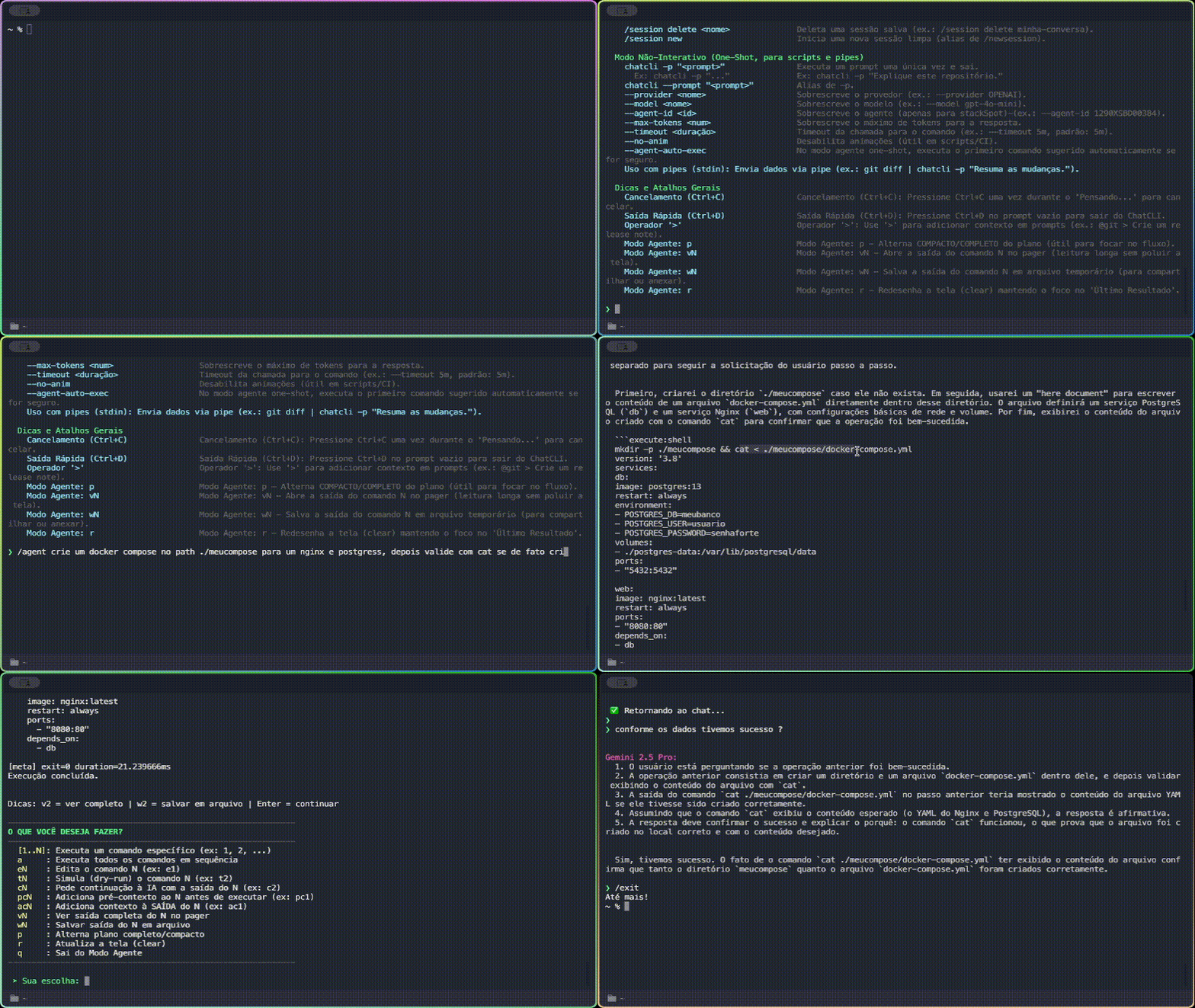
ChatCLI connects the industry's leading LLMs to a single, extensible interface — from
chatcli -pin your terminal to a Kubernetes operator with an autonomous AIOps pipeline, passing through a production-ready gRPC server with authentication, failover, and Prometheus metrics.
| Multi-provider with failover | 14 LLM providers (OpenAI · OpenAI Responses · Anthropic · Bedrock · Google · xAI · ZAI · MiniMax · Moonshot (Kimi) · Copilot · GitHub Models · StackSpot · OpenRouter · Ollama) with intelligent error classification, exponential backoff, and per-provider cooldown. |
| Autonomous agents | 14 built-in workers coordinated by a ReAct engine (Reason + Act): 12 orchestration specialists run in parallel + 2 quality agents (refiner, verifier), plus a 7-pattern quality pipeline. |
| Quality pipeline | Self-Refine, Chain-of-Verification (CoVe), Reflexion, RAG + HyDE, Plan-and-Solve (ReWOO), cross-provider reasoning backbone — all composed via a thread-safe state machine with circuit breakers and hot reload. |
| Scheduler (Chronos) | Durable scheduling with cron + wait-until + DAG + daemon mode. /schedule, /wait, /jobs + @scheduler tool for agents. CRC32 WAL, snapshots, rate limiter, circuit breakers, JSONL audit, 13 Prometheus metrics. Jobs survive crashes and CLI exit. |
| Durable Reflexion | WAL-backed queue with worker pool, dead letter queue, boot replay, exponential retry with jitter — lessons survive process crashes. |
| Semantic convergence | char → Jaccard → embedding cosine cascade for Self-Refine, with LRU/TTL cache and quality regression detection. |
| Production-ready | gRPC + TLS 1.3, JWT + RBAC, AES-256-GCM, rate limiting, audit logging, 50+ Prometheus metrics. |
| Kubernetes-native | Operator with 17 CRDs and an autonomous AIOps pipeline (54+ remediation actions), SLO monitoring, post-mortems. |
| Extensible | Plugins with Ed25519 signature verification, multi-registry skills (skills.sh, ClawHub, ChatCLI.dev), lifecycle hooks, MCP client (stdio + SSE). |
# Homebrew (macOS / Linux)
brew tap diillson/chatcli && brew install chatcli

# Go install
go install github.com/diillson/chatcli@latest

# Pre-built, cosign-signed binaries
# https://github.com/diillson/chatcli/releases
Build from source
git clone https://github.com/diillson/chatcli.git && cd chatcli
go mod tidy && go build -o chatcli

# With version metadata injected via ldflags
VERSION=$(git describe --tags --always --dirty 2>/dev/null || echo "dev")
go build -ldflags "-X github.com/diillson/chatcli/version.Version=${VERSION}" -o chatcliLLM_PROVIDER=OPENAI # OPENAI, CLAUDEAI, BEDROCK, GOOGLEAI, XAI, ZAI, MINIMAX, MOONSHOT,
# COPILOT, GITHUB_MODELS, OLLAMA, STACKSPOT, OPENROUTER
OPENAI_API_KEY=sk-xxxFull provider configuration reference
| Provider | API Key | Model | Extras |
|---|---|---|---|
| OpenAI | OPENAI_API_KEY |
OPENAI_MODEL |
OPENAI_MAX_TOKENS, OPENAI_USE_RESPONSES |
| Anthropic | ANTHROPIC_API_KEY |
ANTHROPIC_MODEL |
ANTHROPIC_MAX_TOKENS |
| AWS Bedrock | IAM / Profile / credentials chain | BEDROCK_MODEL |
AWS_REGION, BEDROCK_CROSS_REGION |
| Google Gemini | GOOGLEAI_API_KEY |
GOOGLEAI_MODEL |
GOOGLEAI_MAX_TOKENS |
| xAI | XAI_API_KEY |
XAI_MODEL |
XAI_MAX_TOKENS |
| ZAI | ZAI_API_KEY |
ZAI_MODEL |
ZAI_MAX_TOKENS |
| MiniMax | MINIMAX_API_KEY |
MINIMAX_MODEL |
MINIMAX_MAX_TOKENS |
| Moonshot (Kimi) | MOONSHOT_API_KEY |
MOONSHOT_MODEL |
MOONSHOT_MAX_TOKENS, MOONSHOT_THINKING |
| GitHub Copilot | GITHUB_COPILOT_TOKEN |
COPILOT_MODEL |
or /auth login github-copilot |
| GitHub Models | GITHUB_TOKEN |
GITHUB_MODELS_MODEL |
GH_TOKEN, GITHUB_MODELS_TOKEN |
| StackSpot | CLIENT_ID, CLIENT_KEY |
— | STACKSPOT_REALM, STACKSPOT_AGENT_ID |
| OpenRouter | OPENROUTER_API_KEY |
— | OPENROUTER_MAX_TOKENS, OPENROUTER_FALLBACK_MODELS |
| Ollama | — | OLLAMA_MODEL |
OLLAMA_ENABLED=true, OLLAMA_BASE_URL |
| OpenAI (Responses API) | OPENAI_API_KEY |
OPENAI_MODEL |
OPENAI_RESPONSES_API_URL |
|
AI-powered terminal with a Bubble Tea TUI, project context, tool calling, and autonomous agents. chatcli
chatcli -p "Explain this repo"
git diff | chatcli -p "Summarize" |
Shared backend with TLS 1.3, JWT/RBAC, failover, Prometheus metrics, MCP, and plugin discovery. chatcli server --port 50051 \
--token my-token
chatcli connect \
--server host:50051 \
--token my-token |
Autonomous AIOps pipeline with 17 CRDs, 54+ remediation actions, SLO monitoring, and post-mortems. helm install chatcli-operator \
oci://ghcr.io/diillson/charts/chatcli-operator \
--namespace chatcli-system \
--create-namespace |
The scheduler runs embedded in the CLI and optionally as a daemon. Jobs survive restarts via WAL + snapshot.
# Fire a command in 30s
/schedule ping --when +30s --do "/run curl https://api.example.com/health"

# Daily cron with retry
/schedule backup --cron "0 2 * * *" --do "shell: ./backup.sh" --max-retries 3

# Deploy + K8s wait + trigger smoke
/schedule deploy --when +0s --do "shell: terraform apply -auto-approve" \
  --wait "k8s:deployment/prod/api:Available" --timeout 15m \
  --triggers smoke-tests

# Daemon to keep running with the CLI closed
chatcli daemon start --detach
chatcli daemon status

# List / inspect / cancel
/jobs list
/jobs show <id>
/jobs tree
/jobs cancel <id>
Agents get the @scheduler tool and can pause themselves waiting on conditions — see Cookbook: scheduler automation and the feature doc.
Context commands (CLI mode)
Inject environment data directly into your prompt:
| Command | Description |
|---|---|
@git |
Status, branches, and recent commits |
@file <path> |
File or directory contents |
@env |
Environment variables |
@history |
Recent shell commands |
@command <cmd> |
Execute a command and inject its output |
Kubernetes manifest example (Instance CRD)
apiVersion: platform.chatcli.io/v1alpha1
kind: Instance
metadata:
  name: chatcli-prod
spec:
  provider: ZAI
  model: glm-5
  replicas: 2
  fallback:
    enabled: true
    providers:
      - name: OPENAI
        model: gpt-5.4
      - name: MINIMAX
        model: MiniMax-M2.7
helm install chatcli oci://ghcr.io/diillson/charts/chatcli \
--namespace chatcli --create-namespace \
--set llm.provider=OPENAI --set secrets.openaiApiKey=sk-xxx14 providers with a unified interface. Automatic failover with intelligent error classification, cross-provider extended thinking, and prompt caching where available.
| Provider | Default Model | Tool Calling | Vision | Reasoning / Thinking |
|---|---|---|---|---|
| OpenAI | gpt-5.4 | Native | Yes | reasoning_effort (o-series / gpt-5) |
| Anthropic (Claude) | claude-sonnet-4-6 | Native | Yes | Extended thinking with cache |
| AWS Bedrock | claude-sonnet-4-5 | Native | Yes | Thinking budget (Anthropic models) |
| Google Gemini | gemini-2.5-flash | Native | Yes | — |
| xAI (Grok) | grok-4-1 | XML fallback | — | — |
| ZAI (Zhipu AI) | glm-5 | Native | Yes | — |
| MiniMax | MiniMax-M2.7 | Native | Yes | — |
| Moonshot (Kimi) | kimi-k2.6 | Native | Yes | MOONSHOT_THINKING=enabled|disabled|auto |
| GitHub Copilot | gpt-4o | Native | Yes | — |
| GitHub Models | gpt-4o | Native | Yes | — |
| StackSpot AI | StackSpotAI | — | — | — |
| OpenRouter | openai/gpt-5.2 | Native | Yes | Passthrough |
| Ollama | (local) | XML fallback | — | <thinking> tag normalization |
| OpenAI (Responses API) | gpt-5.4 | Native | Yes | reasoning_effort |
# Configurable fallback chain
CHATCLI_FALLBACK_PROVIDERS=OPENAI,CLAUDEAI,BEDROCK,ZAI,MINIMAX,MOONSHOT,OPENROUTER
/thinking on|off|auto enables extended thinking / reasoning_effort on any provider that supports it — the cross-provider mapping is automatic.
ReAct engine (Reason + Act) with 14 built-in agents: 12 orchestration specialists running in parallel (
file, coder, shell, git, search, planner, reviewer, tester, refactor, diagnostics, formatter, deps) + 2 quality-harness agents (refiner,verifier).
/coder "Refactor the auth module to use JWT"
chatcli -p "Create tests for the utils package" --agent-auto-exec| Agent | Responsibility |
|---|---|
| File | File reading, writing, and manipulation |
| Coder | Code generation and editing |
| Shell | System command execution |
| Git | Version control operations |
| Search | Code and file search |
| Planner | Complex task decomposition (Plan-and-Solve / ReWOO) |
| Reviewer | Automated code review |
| Tester | Test generation and execution |
| Refactor | Safe code refactoring |
| Diagnostics | Problem analysis and debugging |
| Formatter | Formatting and linting |
| Deps | Dependency management |
| Refiner | Self-Refine post-hook (critique → revise) |
| Verifier | Chain-of-Verification (questions + final answer) |
Workers are coordinated by the dispatcher with a configurable semaphore (CHATCLI_AGENT_MAX_WORKERS), retry policy, and FileLockManager synchronization.
Seven prompting/execution patterns composed via a pluggable pipeline with state machine, hot reload, and per-hook isolation.
| # | Pattern | Status | Opt-in |
|---|---|---|---|
| 1 | ReAct (Reason + Act) | ✅ agent core | — |
| 2 | Plan-and-Solve / ReWOO | ✅ | /plan, CHATCLI_QUALITY_PLAN_FIRST_MODE |
| 3 | Reflexion (with durable queue) | ✅ | on by default |
| 4 | RAG + HyDE | ✅ | CHATCLI_QUALITY_HYDE_ENABLED=1 |
| 5 | Self-Refine (with semantic convergence) | ✅ | CHATCLI_QUALITY_REFINE_ENABLED=1 |
| 6 | Chain-of-Verification (CoVe) | ✅ | CHATCLI_QUALITY_VERIFY_ENABLED=1 |
| 7 | Cross-provider reasoning backbone | ✅ | CHATCLI_QUALITY_REASONING_MODE=auto |
- State machine (Active → Draining → Closed) with atomic CAS transitions.
- Copy-on-Write via
atomic.Pointer[snapshot]—AddPre/AddPost/SwapConfigare atomic, zero locks on the hot path. - Per-hook isolation: panic recovery, timeout enforcement (default 30s), circuit breaker (5 failures → open for 30s).
- Priority-based ordering via optional
Prioritizedinterface (backward-compatible — unmarked hooks default to 100). - Short-circuit sentinels:
ErrSkipExecution(cache-hit beforeagent.Execute) andErrSkipRemainingHooks(ensemble patterns). - Graceful shutdown via
DrainAndClose(timeout)honoring in-flight calls.
Reflexion triggers (error, hallucination flagged by CoVe, low quality) flow through a lesson queue with enterprise guarantees — lessons survive process crashes:
- WAL with double CRC32, atomic rename, dir fsync — torn writes detected automatically.
- Worker pool (default 2) with per-job timeout, exponential backoff with jitter, configurable
MaxAttempts. - Persistent DLQ (same WAL format) with
/reflect failed,/reflect retry <id>,/reflect purge <id>. - Drain-on-boot: pending lessons from a previous session are reprocessed automatically.
- Idempotency via
sha256(task | trigger | attempt)— re-triggering the same situation is a no-op. - Stale discard (default 7d) — old lessons dropped at replay time.
/reflect list              # current queue + DLQ
/reflect failed            # DLQ with last error per entry
/reflect retry <job-id>    # re-queue a failed lesson
/reflect purge <job-id>    # permanently remove a DLQ entry
/reflect drain # force WAL replaySelf-Refine uses a char → Jaccard → embedding cascade to detect when to stop iterating. Catches "same meaning, different words" that the char-level heuristic missed:
| Stage | Cost | When it fires |
|---|---|---|
| Char | μs | Always. Early-exit when sim > 0.99 (identical) or sim < 0.3 (diverged) |
| Jaccard | ms | Borderline, normalized token sets with EN/PT stop-words |
| Embedding | ms + $ | Borderline after Jaccard. Opt-in via CHATCLI_QUALITY_REFINE_CONVERGENCE_EMBEDDING=1 |
- LRU cache with TTL (default 256 entries / 5min) avoids re-embedding identical text.
- Per-scorer circuit breaker — provider outage degrades to Jaccard without blocking refine.
- Quality regression detection: when pass N gets worse (>15% sim loss vs best) → revert to best draft + set
refine_rolled_backmetadata so Reflexion can learn. - Strict mode: refuses to declare convergence without embedding when stakes are high.
Full quality pipeline config
# Master switch
CHATCLI_QUALITY_ENABLED=true

# Self-Refine (#5) + semantic convergence
CHATCLI_QUALITY_REFINE_ENABLED=false            # opt-in
CHATCLI_QUALITY_REFINE_MAX_PASSES=1
CHATCLI_QUALITY_REFINE_CONVERGENCE_ENABLED=true
CHATCLI_QUALITY_REFINE_CONVERGENCE_EMBEDDING=false
CHATCLI_QUALITY_REFINE_CONVERGENCE_STRICT=false

# Chain-of-Verification (#6)
CHATCLI_QUALITY_VERIFY_ENABLED=false
CHATCLI_QUALITY_VERIFY_NUM_QUESTIONS=3
CHATCLI_QUALITY_VERIFY_REWRITE=true

# Reflexion (#3) + durable queue
CHATCLI_QUALITY_REFLEXION_ENABLED=true
CHATCLI_QUALITY_REFLEXION_QUEUE_ENABLED=true    # WAL + worker pool + DLQ
CHATCLI_QUALITY_REFLEXION_QUEUE_WORKERS=2
CHATCLI_QUALITY_REFLEXION_QUEUE_MAX_ATTEMPTS=5
CHATCLI_QUALITY_REFLEXION_QUEUE_STALE_AFTER=168h

# Plan-and-Solve / ReWOO (#2)
CHATCLI_QUALITY_PLAN_FIRST_MODE=auto             # off|auto|always

# HyDE (#4)
CHATCLI_QUALITY_HYDE_ENABLED=false
CHATCLI_QUALITY_HYDE_USE_VECTORS=false

# Reasoning backbone (#7)
CHATCLI_QUALITY_REASONING_MODE=auto              # off|on|auto
CHATCLI_QUALITY_REASONING_BUDGET=8000
All exposed via /config quality with runtime state (registered hooks, queue depth, DLQ size).
End-to-end Prometheus integration in the
chatclinamespace. 50+ metrics covering LLM, agents, pipeline, queue, and lesson queue.
chatcli server --port 50051 --metrics-port 9090
curl http://localhost:9090/metrics | grep chatcli_
curl http://localhost:9090/healthz| Subsystem | Metric | Type |
|---|---|---|
chatcli_llm_* |
requests_total, request_duration_seconds, tokens_used_total, errors_total |
Counter, Histogram |
chatcli_quality_pipeline_* |
dispatch_total, hook_duration_seconds, hook_errors_total, hook_circuit_state, generation |
Counter, Histogram, Gauge |
chatcli_lessonq_* |
enqueue_total, queue_depth, dlq_size, processing_duration_seconds, wal_corruption_total, retry_total |
Counter, Gauge, Histogram |
chatcli_session_* |
duration, commands executed, signals | Counter, Gauge |
chatcli_grpc_* |
unary + stream interceptors | Counter, Histogram |
Standard Go runtime and process_* collectors are registered automatically.
Security is not a feature flag. It is the foundation of every layer of ChatCLI.
|
Authentication & authorization
Encryption
Network
|
Plugin & agent security
Auditing & compliance
CI/CD security
|
Built-in OAuth
/auth login openai-codex       # OAuth PKCE + local callback
/auth login anthropic          # OAuth PKCE + manual code
/auth login github-copilot     # Device Flow (RFC 8628)
/auth status                   # All provider status
Credentials are stored with AES-256-GCM at ~/.chatcli/auth-profiles.json.
| Category | Commands |
|---|---|
| Core | /help · /version · /reload · /exit · /reset |
| Sessions | /session {save,load,list,delete,new,fork,search} · /export · /newsession · /rewind |
| Context | /context {create,attach,list,remove} · @git · @file · @env · @history · @command |
| Config | /config [section] · /status · /settings · /switch <provider|model> |
| Agent mode | /agent [task] · /run · /coder · /plan [query] · /moa <prompt> |
| Quality pipeline | /thinking [on|off|auto] · /refine [draft] · /verify [answer] · /reflect [list|failed|retry|purge|drain|<text>] |
| Memory & graph | /memory {longterm,list,profile,facts,remember,forget,profile set,compact} · @memory (remember/recall/forget/profile/neighbors/map) — profile with lifecycle: list fields upsert (restating an item supersedes instead of duplicating) and _replace/_done/_remove key suffixes rewrite (e.g. goals_done= removes the finished goal; record milestone= and certifications= alongside); new interests, directives (hard rules vs preferences; per-project scope with "[scope:<project>] rule" — injected only when the matching workspace is active), milestone (dated timeline), stance (technical position with its why, "position :: reason") and env_<key> (structured environment) fields; per-field provenance+freshness (user vs extraction, re-affirmation bumps confirmed_at, aging fields get flagged as possibly stale) and a privacy tier (finance/health/family keys auto-tagged [sensitive]: they personalize answers but never enter code/examples/artifacts; sensitive_mark/sensitive_unmark); daily notes consolidate into weekly and monthly digests (Trajectory section in context); profile updates also work in chat (sanctioned exception, /config chat memory, CHATCLI_CHAT_MEMORY) · /graph [subject] · /compact [ratio] |
| Extensibility | /mcp {init,list,invoke,config} · /plugin {list,load,unload} · /skill <name> · /hooks {list,enable,disable,test} |
| Messaging & Servers | /gateway {start,status} (Telegram/Slack/Discord/WhatsApp/webhook) · chatcli mcp-server · chatcli acp |
| Remote | /auth {login,logout,status} · /connect <server> · /disconnect |
| Tools | /watch {pid|file} · /worktree {create,list,remove} · /channel {create,switch} · /websearch <query> · /lsp <file> |
| Scheduler | /schedule <name> --when <t> --do <a> · /wait --until <cond> · /jobs {list,show,tree,cancel,pause,resume,logs,daemon} · chatcli daemon {start,stop,status,ping,install} |
| Diagnostics | /metrics · /cost · /ratelimit (/limits) |
Every feature is designed to compose with the others. Plugins discover skills. Hooks drive tools. Contexts feed agents.
| Feature | Description |
|---|---|
| Native tool calling | Native APIs from OpenAI, Anthropic, Bedrock, Google, ZAI, MiniMax, Moonshot, OpenRouter. ephemeral cache for Anthropic. Automatic XML fallback for providers without native support. |
| MCP (Model Context Protocol) | Client via stdio and SSE for expanded context. Server (chatcli mcp-server) exposes chat, agent, coder and built-in tools; ACP mode (chatcli acp) for editors. |
| Chat Gateway | Runs as a messaging daemon (Telegram, Slack, Discord, WhatsApp, webhook): each message runs through the agent loop and progress is streamed back to the chat. Voice messages are transcribed (local-first whisper) and answered in voice by default (CHATCLI_GATEWAY_VOICE_REPLY=auto|always|never); each conversation controls it by asking in natural language ("answer me in audio" / "stop sending audio") via the @voice tool, with the preference persisted. |
| Embedded voice (TTS) | CHATCLI_TTS_PROVIDER=embedded — offline Kokoro neural voice, no API key and no cgo: downloads the sherpa-onnx engine + model once (~150MB) and works the same on Linux/macOS/Windows. Routes pt-BR/English by reply language (CHATCLI_TTS_VOICE=bm_george, CHATCLI_TTS_VOICE_PT=pm_alex); the other backends (say/espeak, self-hosted, OpenAI/Groq/Gemini) remain available. |
| Embedded transcription (STT) | Offline multilingual Whisper via sherpa-onnx, no API key and no cgo — and the automatic fallback: with nothing configured, the gateway downloads the engine + an ONNX model once (~200MB for base; CHATCLI_TRANSCRIPTION_MODEL=tiny|base|small|…) at startup and transcribes voice notes auto-detecting the spoken language. OGG/Opus voice notes (Telegram/WhatsApp) decode in pure Go — no ffmpeg needed; only residual formats (mp3/m4a) require ffmpeg, and the gateway preflight + /gateway status warn with your platform's install command. CHATCLI_TRANSCRIPTION_PROVIDER=embedded forces it over the other backends (local whisper CLI, self-hosted, Groq/OpenAI), which remain available. |
| Mixture-of-Agents | /moa — several models propose in parallel and an aggregator synthesizes (Wang et al., 2406.04692). Every participant gets the same briefing as a chat turn (attached contexts, workspace memory, skills) plus read-only knowledge retrieval, CCR recall and long-term memory recall. |
| LSP diagnostics | /lsp <file> — compiler errors/warnings via the Language Server Protocol (gopls, pyright, rust-analyzer, clangd, …). |
| Rate limits | /ratelimit — provider limits parsed from x-ratelimit-* headers (requests/tokens, % used, reset). |
| Trajectory export | /export — current conversation as ShareGPT JSONL for fine-tuning/analysis. |
| Persistent contexts | /context create, /context attach — inject whole projects into the system prompt with cache hints. |
| Knowledge base (keyless RAG) | /context create docs corpus.jsonl --mode knowledge — documentation corpora (e.g. JSONL from the builtin @docs-flatten tool, which flattens local or git-repo Markdown/MDX docs) become a knowledge base: attaching injects only an index card (~900 fixed tokens, even at 6MB+) and relevant passages are retrieved per turn via pure-Go BM25 (no API key) + embeddings when configured. The @knowledge tool (search/get/toc) interrogates the base iteratively in agent/coder and also in chat (read-only exception, /config chat knowledge) — including authoring skills from the docs with @skill. |
| Bootstrap & Memory | SOUL.md, USER.md, IDENTITY.md, RULES.md + long-term memory with facts (confidence + provenance + contradiction reconciliation), topics with rolling summaries, and decay. |
| Self-evolution | Skills author and evolve themselves on the memory extraction pass (no extra LLM call): reusable procedures become auto-activating skills; an insight evolves an existing skill by additive merge, with a reversible backup (@skill restore). CHATCLI_SELFEVOLVE_MODE=off|suggest|auto; observability under /config selfevolve. |
| Knowledge graph (Obsidian in the core) | Facts, topics, projects, skills and tags become an on-demand graph: @memory neighbors <subject> / map pull backlinks and related notes, a tiny index card rides each turn, and /graph [subject] renders the graph to an image (embedded go-graphviz). CHATCLI_GRAPH_INDEX=on|off. |
| Plugins | Auto-detection, schema validation, Ed25519 signatures, remote plugins. |
| Skills | Self-authoring (@skill), multi-registry (skills.sh, ClawHub, ChatCLI.dev), fuzzy search, security audits, source preferences, atomic install. |
| Custom personas | Markdown with YAML frontmatter (model, tools, skills). |
| Hooks | PreToolUse, PostToolUse, SessionStart/End, UserPromptSubmit, Pre/PostCompact — shell or webhook. |
| WebFetch / WebSearch | DuckDuckGo + fetch with text extraction. |
| Cost tracking | Per-session cost with per-provider pricing tables. |
| Git Worktrees | Isolated work on parallel branches. |
| K8s Watcher | Multi-target: metrics, logs, events, Prometheus scraping. |
| i18n | Portuguese and English with automatic detection. |
| Session management | Save, load, fork, export. |
chatcli/
  cli/
    agent/
      quality/              7-pattern pipeline (state machine + COW snapshots)
        convergence/        Semantic convergence (char → jaccard → embedding)
        lessonq/            Reflexion durable queue (WAL + worker pool + DLQ)
      workers/              14 agents + dispatcher + FileLockManager
    hooks/                  Lifecycle events (shell/webhook)
    mcp/                    MCP client (stdio + SSE)
    plugins/                Plugin manager + signature verification
    scheduler/              Chronos — durable scheduler (WAL + cron + DAG + daemon)
      condition/            10 evaluators (shell, http, k8s, docker, tcp, llm, ...)
      action/               8 executors (slash, shell, agent, webhook, ...)
      builtins/             Aggregated registry for evaluators + executors
    workspace/memory/       Facts, topics, patterns, vector index (HyDE)
    tui/                    Bubble Tea adapters
  llm/
    openai/  openai_responses/  openai_assistant/
    claudeai/  bedrock/
    googleai/  xai/  zai/  minimax/
    copilot/  github_models/  stackspotai/  openrouter/  ollama/
    fallback/  catalog/  registry/  token/  toolshim/  embedding/
  metrics/                  Prometheus registry + /metrics + /healthz
  server/                   gRPC + TLS + JWT + MCP + plugin discovery
  operator/                 Kubernetes Operator (17 CRDs, AIOps pipeline)
  k8s/                      Watcher (collectors, store, summarizer)
  models/                   ToolDefinition, ToolCall, LLMResponse, Message
  auth/                     OAuth PKCE, Device Flow, AES-256-GCM store
  config/                   ConfigManager with versioned migration
  i18n/                     embed.FS + golang.org/x/text (PT / EN)
Design principle: each package declares its own interfaces and self-registers. The
llm/registry lets you add a new provider by implementing a single interface. The quality pipeline is pluggable viaAddPre/AddPostwith atomic swap. The operator coordinates independent CRDs via the controller pattern.
- CI (
.github/workflows/1-ci.yml): golangci-lint, gofmt,go vet,go test -race -coverprofile, coverage HTML as artifact. - Security scan (
security-scan.yml): continuous Trivy image scanning. - Release automation (
release-please+publish-release.yml): multi-platform builds, cosign signatures, CycloneDX SBOM, ArtifactHub publishing. - Makefile:
make build,make test,make lint,make installwithVersion,CommitHash,BuildDateinjected via ldflags.
- Fork the repository
- Create a branch from
main:git checkout -b feature/my-feature - Commit and push
- Open a Pull Request
See docs/ for detailed architecture, quality pipeline, and operator guides.
Documentation • Releases • Helm Charts • Go Reference • Issues